Traditionally, community garden programs raise “single-set” (i.e. loose or individual) oyster which are then planted on the bay bottom at a suitable location, typically near the gardening area. Planted oysters thrive in these areas, filtering the water, providing habitat, and spawning every year to increase the population within the water body complex they were located. After working with the regulators from NYSDEC, the use of a different form of oyster, known as “spat-on-shell” (SOS), was approved to be used on a “case-by-case” basis for the community gardens in the uncertified water bodies. SOS oysters are the same species, but they grow on a recycled piece of shell, as opposed to individual oysters. As SOS oysters grow, they turn into 3D cluster structures which collectively improve the infrastructure and health of our local reefs.
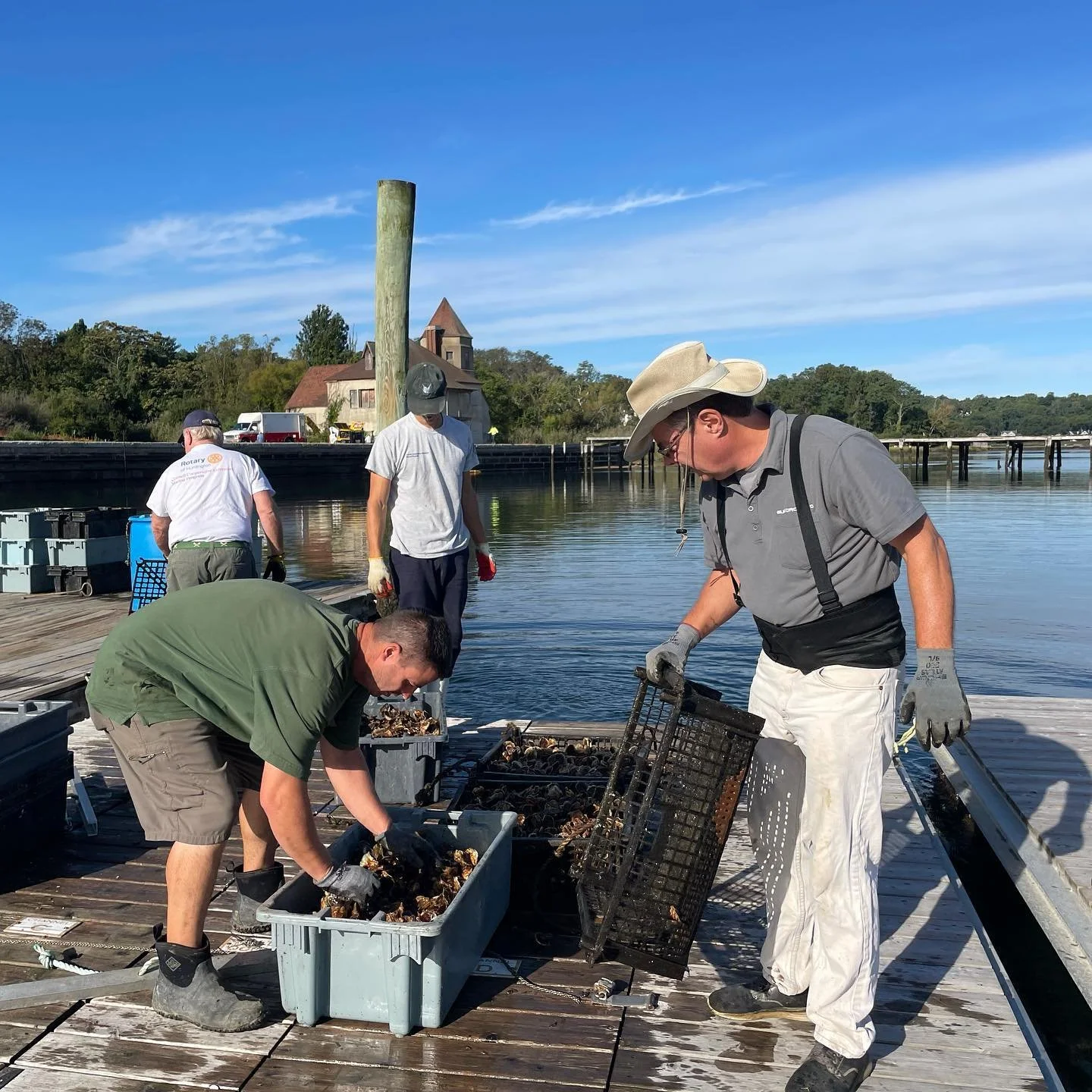
After receiving approval from the NYSDEC to use SOS for the gardening program, new grow-out structures needed to be designed instead of the typical floating oyster bags used to raise singe-set oyster. This was needed because SOS oysters grow three-dimensionally to form small oyster reef clusters, but if raised in the oyster bags, they are nearly impossible to remove. This led to the development of the crate system (i.e., modified milk crates), and other methods currently used by CCE Marine’s team.
In the summer of 2021, a pilot test was conducted by CCE Marine staff to raise SOS oysters in the milk crate system for the first time. Previous restoration efforts using SOS oyster were done by planting the shell on the bay bottom while the oysters were still very small (e.g., 5-10mm), so it was unknown how well they would grow in the crates. The Cassamassima family, who had previously been part of the program in Oyster Bay/Cold Spring Harbor and belonged to the Huntington Yacht Club (HYC), were the first members of the CCE’s Shellfish CARE program. A total of 5 crates were sponsored by them and other members from the HYC and 2 additional crates were raised nearby by CCE Marine at their shellfish nursery at Gold Star Battalion Beach. Oyster SOS was received from the hatchery at the end of June and grew better than expected, to the point where each milk crate became too full and had to be split into 7 more crates, for a total of 14 crates. By the first week of September, oysters reached 1.5” (38mm) in average size and were ready to be deployed on the bay bottom. This first cohort of approximately 17,500 oysters was planted around the Huntington Lighthouse since the NYSDEC had not approved the current planting location near the nursery at Gold Star Battalion Beach.
Building on the success of our first year, in 2022 HYC had more members join and raised 20 crates. Northport and Centerport Yacht Clubs also joined, starting small by raising 6 crates each. The Huntington Rotary Club also partnered with CCE Marine to adopt and fund two floating docks worth of setting trays (a similar but larger grow-out system than the crates). There were over 250 community members involved in 2022, ranging in age from 8 to 75 years. The new sanctuary was also approved that year which allowed for the approximate 172,000 SOS oysters to be strategically planted by SCUBA divers, forming the beginnings of a new oyster reef. Upon planting the oysters and forming the reef, the habitat was immediately occupied by several fish species including juvenile Black Sea Bass, Cunner, Tautog, and many adult Scup.
The Beginning of C.A.R.E.
The Shellfish Community Aquaculture Restoration and Education (C.A.R.E.) Program was officially launched in 2021, but development began in 2019. The purpose of the program is to provide an opportunity for local community members to participate in restoration efforts focusing on improving water quality and restoring oyster habitat. This hands-on approach allows program participants to learn about shellfish aquaculture and the benefits the organisms have on local water bodies. This is a unique opportunity for community members of all ages and backgrounds to participate in a restoration activity that fosters a different type of connection to their local waters.
Cornell Cooperative Extension of Suffolk County’s Marine Program (CCE Marine) had partnered with the Oyster Bay/Cold Spring Harbor Protection Committee to develop their community gardening program in 2017 which started in Laurel Hollow. As their program expanded, there was significant interest from local community members to join the program, however, many were from towns beyond Oyster Bay. Many residents of the Town of Huntington were interested in a program with their water bodies, however, there were limited locations suitable to implementing the same model used in Oyster Bay. The New York State Department of Environmental Conservation (NYSDEC) has regulations in place that do not allow for the culture of oyster in uncertified water bodies. This acts as a safeguard to the public from consuming shellfish raised in these locations due to the potential contamination from wastewater treatment facilities and/or harmful algae blooms. Since the inner harbors in Huntington are uncertified for shellfish, there needed to be modifications made to the program to create community gardens. If you would like to learn more about the NYSDEC regulations, please click the link below.